
Disclaimer: This article shares general home organization tips based on personal experience. It is not professional advice and may not fit every situation. Always adapt decluttering and cleaning routines to your own home, needs, and safety.
Introduction: Why a 20 minute declutter checklist changes everything
If someone has ever stared at a messy room and felt completely overwhelmed, a simple 20 minute declutter checklist can give them a clear, doable path to reset one space without losing their whole evening. Instead of trying to “fix the whole house,” this approach focuses on one room, one timer, and one realistic win.
Across American homes, people are juggling work, kids, pets, and a never-ending to-do list. In that chaos, a quick decluttering routine often feels like a fantasy. Traditional cleaning advice can sound like it was written for empty houses and unlimited time.
A typical speed cleaning checklist for home rarely accounts for backpacks on the floor, half-finished art projects, or someone trying to reheat leftovers while answering emails.
This article walks through a practical, lived-in system that real households use every day. It’s built on simple systems instead of perfection, and it turns “I’ll never catch up” into “I can handle 20 minutes.” By the end, readers will have a repeatable framework to reset a messy room quickly, even on the busiest weeknights.
What this kind of checklist really is – and why a one room declutter plan works
At its core, this method is a focused, time-boxed one room declutter plan. Instead of floating from room to room, the person picks a single space, sets a timer for 20 minutes, and follows the same steps every time.
Unlike a deep clean, a daily room reset checklist is about maintenance, not perfection. It focuses on things that are seen and used every day: floors, surfaces, dishes, laundry, and the items that tend to pile up. Over time, it becomes a simple home reset routine that keeps spaces functional, even if every drawer isn’t Instagram-ready.
Many people arrived at this approach after burning out on all-day cleaning marathons. They tried to do everything in one weekend, only to feel exhausted and discouraged. That’s when a simple tidy up routine started to make more sense: small, repeatable steps that actually fit inside real life.
A timer is at the heart of this method. For anyone wondering how to declutter fast when you are busy, the answer is to shrink the task to something that feels doable right now. Twenty minutes is long enough to make a visible difference, but short enough to squeeze between work calls, kids’ bedtime, or a favorite show. The goal isn’t magazine minimalism; it’s to make the room usable and calm again.
Before starting: mindset, expectations, and a realistic decluttering schedule
Most people don’t get stuck because they don’t know how to tidy. They get stuck because they don’t know what to do first when a room feels overwhelming. Their brains see every mess at once: laundry on the chair, mail on the table, toys on the floor, dishes in the sink.
On top of that, there are the unhelpful phrases people use when they feel overwhelmed by clutter:
- “The house is a disaster.”
- “It will take me days to fix this.”
- “I’m just not an organized person.”
Those stories quietly kill motivation. A more helpful story sounds like: “This room needs help, but I only have to deal with 20 minutes right now.”
From there, it helps to commit to a realistic decluttering schedule. Instead of promising a massive overhaul, many families agree on one 20-minute block per day and a slightly longer session on weekends.
A tidy home daily checklist that fits into a once a day room reset is far more sustainable than a single, exhausting deep clean.
Experts like Marie Kondo and the KonMari Method popularized the idea of intentional decluttering, but not everyone has the time or energy for a full category-by-category makeover.
This room-based, timer-based approach respects those same principles—deciding what truly deserves to live in a space—but in a much smaller, more forgiving package.
The core framework: a simple home reset routine in 20 minutes
Step by step declutter guide (minute-by-minute)
A good step by step declutter guide works in any room: living room, bedroom, kitchen, or bath. Here’s the basic structure many households follow to reset a messy room quickly:
- Minutes 0–2: Stand in the doorway and choose your target zones.
- Floors, main surfaces, and the biggest visual clutter come first.
- This stops people from wandering and tackles quick cleaning tasks that make a big impact.
- Minutes 2–7: Trash and obvious “does not belong here” items.
- Grab a bag for trash and a bin for items that belong elsewhere.
- This is the first round of easy decluttering tasks you can finish today.
- Minutes 7–14: Surfaces and visible storage.
- Tables, counters, open shelves—anything the eye lands on immediately.
- The goal is to reclaim space and calm the room.
- Minutes 14–20: Put-back sprint and quick tidy.
- Return items to their actual homes.
- Straighten cushions, fold blankets, align chairs, and do a mini quick house tidy routine.
This structure shows exactly how to break a big declutter into smaller tasks that fit inside a short timer. It also teaches how to tidy one room without getting distracted by laundry in the hallway or dishes in another room; everything outside the target space waits until tomorrow’s session.
The 4-stage simple room reset method
This method is a simple room reset method that supports long-term room by room clutter control. Each stage is brief, but together they dramatically change how a space feels.
Stage 1 (2–3 minutes): fast scan and trash sweep
In Stage 1, the person focuses only on trash and obvious “gone for good” items. They’re practicing what to throw away first when decluttering:
- Empty packaging
- Broken toys
- Expired coupons or mail
- Dead pens, dried-up markers, broken hangers
Keeping a small bin or a couple of Sterilite plastic totes nearby makes this sweep much easier. This is the fastest way to build momentum when someone needs easy decluttering tasks you can finish today to feel like they’re winning again.
Stage 2 (5–7 minutes): fast way to clear surfaces and counters
Stage 2 is all about reclaiming surfaces. A fast way to clear surfaces and counters is to commit to one category at a time—dishes, papers, random items—rather than picking up whatever is closest.
Micro-task example: 60-second counter reset
A 60-second sprint on a single counter can be surprisingly powerful. In the kitchen, a simple kitchen clutter clean up plan might be:
- Move dirty dishes to the sink or dishwasher.
- Put away food and pantry items.
- Wipe the counter with a cloth or Clorox disinfecting wipes.
In the bathroom, a bathroom counter declutter list could look like:
- Put daily products back into baskets.
- Toss empties.
- Wipe down the vanity and faucet.
By focusing on visible planes, the person discovers how to clear visual clutter in one room so the brain immediately registers “cleaner,” even if cupboards aren’t perfect yet.
Stage 3 (5–7 minutes): simple routine to put things back where they belong
Now it’s time for a simple routine to put things back where they belong. This is where storage choices really matter.
Micro-task example: grab-and-go basket sweep
A common trick is to walk the room with a basket, sweep in everything that belongs elsewhere, and then do a quick re-delivery run.
Tip: play a 3-minute song to keep moving while sorting
A short playlist keeps the pace snappy and makes the work feel more like a game than a chore.
Families often rely on laundry basket systems and toy storage cubes here, especially in shared spaces. They become the backbone of clutter cleanup checklist for families efforts:
- One basket for each child’s room
- Toy bins in main living areas
- Catch-all baskets for mail or tech accessories
These choices amplify those easy decluttering tasks you can finish today, because each item finally has a logical “home.”
Stage 4 (2–3 minutes): quick house tidy routine and reset
Stage 4 is the polish. This quick house tidy routine is where the room shifts from “less messy” to “actually feels good.”
People use a short quick home organization checklist for this final pass, including:
- Straightening cushions and throws
- Pushing chairs back in
- Aligning rugs
- Putting remotes, chargers, or controllers where they belong
The secret to how to stay consistent with daily resets is to keep this final stage short, visual, and satisfying. The person should be able to stand in the doorway and genuinely feel proud of what 20 minutes accomplished.
Tools and products that make the reset faster
The right tools don’t magically organize a home, but they do make it easier to combine decluttering with light cleaning. Many American families lean on:
- Swiffer cleaning tools for quick dusting and floor passes.
- Clorox disinfecting wipes for bathroom and kitchen surfaces.
- A Dyson cordless vacuum or Shark upright vacuum for crumbs, pet hair, and high-traffic zones.
Budget-friendly organizers also play a huge role:
- Dollar Tree organizing bins for under-sink storage or kids’ art supplies.
- Rubbermaid storage bins for seasonal décor or sports gear.
- Extra Sterilite plastic totes for rotation toys or out-of-season clothing.
On walls and doors, 3M Command hooks and over the door organizers help add hooks and pockets for jackets, backpacks, or bathroom essentials without drilling holes.
Some households even keep a tiny “reset caddy” ready in a corner: a handheld vacuum, wipes, a few drawer organizers for kitchen overflow, and a couple of bins. It becomes a portable kit that supports the simple home reset routine in any room.
Room-by-room 20-minute declutter checklists
Living room reset checklist: where to start decluttering a messy living room
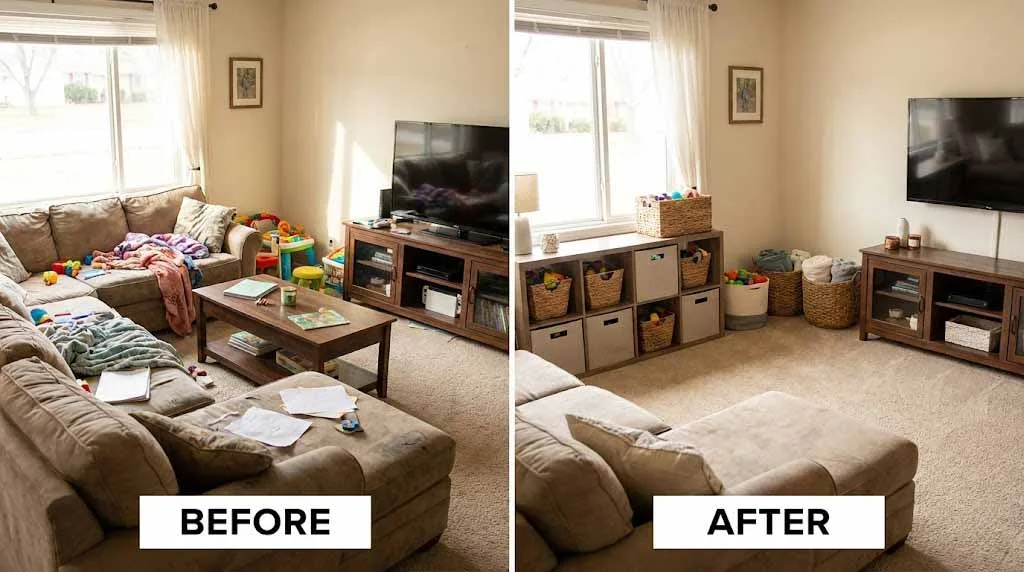
When toys, dishes, and mail are everywhere, people often wonder where to start decluttering a messy living room. A practical living room reset checklist might look like this:
- Trash and dishes to the kitchen.
- Toys into toy storage cubes or baskets.
- Papers into “deal with later” and “recycle” piles.
- Cushions, blankets, and seating straightened.
This sequence focuses on quick cleaning tasks that make a big impact in family spaces. Along the way, a bit of clutter hot spot clean up happens naturally—coffee tables, side tables, TV stands, and arm-rest piles all get attention.
Simple touches like fluffing pillows and rolling blankets are powerful fast room refresh ideas that visually “finish” the room in under 20 minutes.
Kitchen 20-minute reset: how to reset the kitchen after dinner
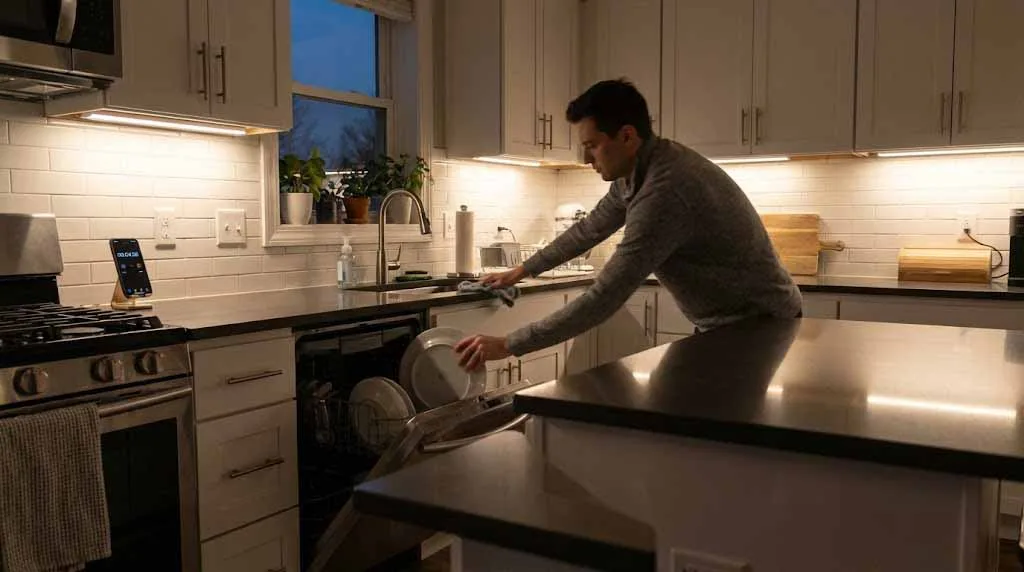
The kitchen is the engine of the home, so how to reset the kitchen after dinner matters a lot. A short kitchen clutter clean up plan can transform groggy mornings:
- Load or rinse dishes.
- Wipe down counters and stove with Clorox disinfecting wipes or a damp cloth.
- Put leftovers away, clear food packages, and deal with snack wrappers.
For many households, this blends into a fast cleaning routine for busy evenings: while food reheats or kids finish homework, someone runs the timer and tackles a corner.
Storage also makes a difference. People use drawer organizers for kitchen tools, snack bins, and labels so clean-up is faster. Some even repurpose under bed storage containers on pantry floors to hold bulk items or rarely used appliances.
Each night, the focus stays on a fast way to clear surfaces and counters—dishes, food, and small appliances—so the room feels open the next morning.
Bedroom clutter reset: simple steps to reset a messy bedroom
In bedrooms, a bedroom clutter reset doesn’t have to mean tearing apart drawers and closets. It can follow simple steps to reset a messy bedroom without overwhelming the person:
- Toss obvious trash.
- Collect laundry into hampers.
- Clear nightstands and dressers.
- Make or straighten the bed.
For rooms with an attached bath, the same session can include how to make a tiny bathroom feel less cluttered by using a mini bathroom counter declutter list—putting products in bins, hanging towels, and wiping the sink.
On nights when energy is low, people focus on how to pick up clutter when you feel tired: they limit themselves to one or two easy decluttering tasks you can finish today, like laundry and surfaces only.
Long-term calm often comes from smarter storage:
- closet shelving systems that make it easier to see clothes.
- shoe rack organizers so shoes don’t pile in corners.
- under bed storage containers for off-season items.
Together, those choices support long-term clutter free home habits rather than one-time efforts.
Bathroom counter declutter list: how to make a tiny bathroom feel less cluttered
Bathrooms are usually small, which means every extra item is noticeable. A good bathroom counter declutter list stays short and repeatable:
- Put daily products into baskets or Dollar Tree organizing bins.
- Toss expired skincare, medicine, or clutter.
- Wipe mirrors, sink, and faucet.
This shows how to tidy up without doing a full deep clean—no one is scrubbing grout during a 20-minute reset. Instead, it focuses on how to make a tiny bathroom feel less cluttered by controlling what’s out on display and keeping counters clear.
Over time, small daily habits to keep clutter away—like putting items back into the same bin every night—mean the space takes seconds, not minutes, to tidy.
Entryway and drop zone: quick habits to keep your entryway clear
Entryways collect life: keys, shoes, bags, mail, sports equipment. Families who master this area rely on quick habits to keep your entryway clear, such as:
- Hooks for bags and coats.
- A shoe shelf instead of a pile.
- A tray or bowl for keys and sunglasses.
Hardware like over the door organizers, 3M Command hooks, and shoe rack organizers gives every item a landing spot, making it far easier to maintain.
A powerful strategy is to decide what to add to a nightly reset checklist for this zone: five minutes to clear shoes, hang bags, and move mail to a basket. This way, mornings start smoother and the main hallway doesn’t become a stress trigger.
Kids’ spaces: how to keep kids’ toys from taking over the house
Parents across the country are looking for realistic ways to handle kids’ rooms and play spaces. A big part of how to keep kids’ toys from taking over the house is designing systems kids can actually use.
That’s where toy storage cubes and color-coded bins come in. Simple pictures or labels on the front show where things go, and the nightly clutter cleanup checklist for families can be turned into a game:
- One song to fill the “stuffed animals” bin.
- One song to clear building blocks.
- One song to put books back on shelves.
A short once a day room reset for playrooms and bedrooms—often around 10 minutes—keeps the chaos in check without constant nagging.
Small apartment decluttering checklist
Space is tighter in apartments, which is why a small apartment decluttering checklist has to respect every square inch. Many renters lean on:
- Vertical shelves instead of extra furniture.
- under bed storage containers for linens and out-of-season clothes.
- Foldable baskets for multipurpose rooms.
They combine these with easy declutter ideas for small apartments: limiting how many duplicates they keep, storing items by frequency of use, and blocking off one cabinet for true “miscellaneous.”
Families in small spaces often rely on realistic decluttering ideas for working families: a quick evening sweep in the living area, then one small project per weekend. Stores like The Container Store and IKEA storage solutions are popular for modular pieces that can adapt to rental life.
Daily, nightly, and weekend routines that keep the home tidy
Daily room reset checklist and daily cleaning and decluttering habits
The households that feel the calmest are rarely the ones that do giant clean-ups; they are the ones with steady daily cleaning and decluttering habits. A simple daily room reset checklist might include:
- Running a 10 minute tidy up checklist in the most-used room.
- Doing dishes or loading the dishwasher.
- One small trash or recycling run.
For caregivers and professionals, a tidy routine for working moms and dads often fits inside a short after work declutter routine. They might reset the living room while kids shower, or straighten the kitchen while something bakes in the oven.
Instead of waiting for motivation, they rely on micro-windows of time—between meetings, phone calls, or errands—to revisit how to declutter fast when you are busy with tiny, focused bursts.
Nightly home reset checklist: simple checklist to tidy up before bed
A nightly home reset checklist keeps the next morning from feeling like a punishment. Most families choose 3–5 non-negotiables:
- Clear and wipe kitchen counters.
- Reset the main living area.
- Tidy the entryway.
A simple checklist to tidy up before bed might even be written and posted on the fridge or stored in a home management binder.
This gentle rhythm shows how to reset the house at the end of the day without turning evenings into another shift of work. Over time, these steps become automatic, which is the real secret behind how to stay consistent with daily resets.
Weekend declutter routine for deeper resets
While weekdays focus on maintenance, a weekend declutter routine creates space for bigger jobs. Instead of one massive slog, many families block one or two sessions of 45–60 minutes.
These sessions are perfect for a beginner decluttering plan:
- One week: kids’ clothes.
- Next week: pantry.
- Following week: linen closet.
Again, the trick is how to break a big declutter into smaller tasks that can be completed in one sitting. A written plan, often kept in a home management binder or inside digital decluttering apps, helps track which areas have been tackled and which ones are next on the realistic decluttering schedule.
Special situations: busy seasons, guests, and families
Fast declutter for busy parents and working moms
School mornings, sports seasons, and overtime at work all demand a different pace. A fast declutter for busy parents routine is built around bare-minimum wins: clear walkways, safe surfaces, and a calm space to sit.
A tailored tidy routine for working moms and other caregivers often identifies non-negotiables—like clear counters, an open couch, or a usable table—and ignores everything else for the day.
On nights when everyone is drained, families lean hard on fast room refresh ideas: throw blankets folded, pillows fluffed, obvious trash gone, and the rest saved for another day.
Quick bedroom reset before guests arrive
When last-minute guests are on the way, a quick bedroom reset before guests arrive can be run just like the 20-minute room routine:
- Trash and laundry first.
- Surfaces cleared and wiped.
- Bed made and pillows fluffed.
Here again, it helps to combine decluttering with light cleaning—a wiped nightstand, fresh pillowcases, and a crumb-free floor make the room feel welcoming.
Some people rely on laundry basket systems to speed this up: they toss stray items into baskets, move them out of sight, and later follow the simple routine to put things back where they belong once guests are gone.
After work declutter routine and end of day house reset
For households out of the house all day, an after work declutter routine can make or break the evening. The key is not to try to fix everything. Instead, they choose one priority room.
This is how many people learn how to reset the house at the end of the day without collapsing:
- Choose one space.
- Run the 4-stage reset.
- Stop when the timer ends.
This rhythm shows that it’s entirely possible to reset messy house one room at a time. Paired with a short quick home organization checklist—perhaps focusing on the most heavily used surfaces—this becomes a sustainable way to live, not a one-time project.
Storage, donations, and ethical decluttering
Smart storage that supports clutter free home habits
Organizing products are tools, not magic wands, but the right ones do support long-term clutter free home habits. Common heroes include:
- closet shelving systems for vertical clothing storage.
- drawer organizers for kitchen utensils and gadgets.
- shoe rack organizers so footwear doesn’t sprawl.
- laundry basket systems tailored to each bedroom or bathroom.
In the United States, many people stock up at the Walmart home organization aisle, Target home organization section, and Bed Bath & Beyond home storage shelves. Others look to IKEA storage solutions, product lines inspired by The Home Edit, or specialized options from The Container Store.
Smaller items also make a big difference:
- under bed storage containers for linens or off-season clothes.
- over the door organizers for accessories, cleaning supplies, or snacks.
- Rubbermaid storage bins for garage, basement, or closet overflow.
The goal is not to buy more stuff but to give existing belongings clear homes that support daily routines.
Where to send unwanted items: donate, sell, or recycle
Decluttering always raises the question of where items should go. Many people don’t want to add more to landfills, which is where donation centers come in.
Organizations like Goodwill Industries, Salvation Army Family Stores, and Habitat for Humanity ReStore accept gently used clothing, furniture, and household goods. For guidance on what to keep, toss, or donate, some people look to the National Association of Productivity and Organizing Professionals (NAPO) for best practices.
And when a home feels truly beyond what a checklist can handle, professional home organizer services can offer hands-on, customized help, especially for neurodivergent adults, seniors, or people facing big life transitions.
Going beyond the physical room: digital decluttering and planning
Extend the 20-minute reset to your digital life
Once the room system is working, many people extend the idea to screens. With digital decluttering apps, they can spend a short session unsubscribing from newsletters, deleting old screenshots, or finally organizing cloud folders.
A home management binder pairs well with this: it can hold printed copies of the checklist, a daily room reset checklist, and a simple weekend declutter routine schedule. This is one of the easiest ways to document how to create a repeatable room reset routine and adjust it over time.
Some families also track a small apartment decluttering checklist, donation lists, or storage maps in the same place, so everyone knows where things live.
Putting it all together: a personalized 20-minute declutter blueprint
When everything comes together, a basic speed cleaning checklist for home evolves into a powerful system. Focused, room-based sessions become a form of room by room clutter control, not just random tidying.
Instead of dreading all-day cleaning marathons, households learn how to tidy up without doing a full deep clean. They know that even easy declutter projects for one room can move them closer to a calmer life.
In practice, the most successful homes rely on:
- Short, predictable routines.
- Clear storage systems.
- Gentle, realistic expectations.
Over time, these choices grow into a lifestyle of clutter free home habits supported by a flexible quick decluttering routine that adapts to changing seasons, jobs, and family needs.
FAQs: 20-minute declutter checklist
1. How does someone start if the whole house feels like a disaster and they don’t know how to declutter fast when you are busy?
The best starting point is not the “worst” room but the one used the most. From there, a person can set a 20-minute timer and follow the four-stage reset: trash, surfaces, put-back, and finishing touches. The key is to stay in that one room, even if other spaces also need attention. Over a week or two, this steadily reduces chaos without demanding a full day off or extra help.
2. What is the first thing someone should do when they walk into a messy room and wonder what to do first when a room feels overwhelming?
The first step is to pause in the doorway and choose priorities: floors and main surfaces. A trash bag and a single bin for “belongs elsewhere” items can strip away much of the overwhelm. Once those are moving, the room no longer feels impossible, and the person can follow the rest of the routine without second-guessing every choice.
3. How can a daily room reset checklist help without stealing the entire evening?
A well-designed daily room reset checklist focuses on 10–20 minutes in just one space. It might include dishes, a quick floor sweep, and a simple surface pass. Over time, this builds muscle memory, so the steps happen faster and with less mental effort. It’s a way of protecting future time, because mornings and weekends feel lighter.
4. What should someone throw away first when decluttering if they only have 10–20 minutes?
For a brief session, what to throw away first when decluttering is anything that is obviously trash or has no future use: broken items, expired food, junk mail, dried-up pens, and packaging. Removing these items first creates breathing room and makes the next decisions easier.
5. How do they decide where to start decluttering a messy living room versus the kitchen or bedroom?
A helpful rule is to pick the room that causes the most daily stress. If walking into the lounge feels like hitting a wall, starting there makes sense. If mornings are painful because the counters are buried, then the kitchen becomes the priority. Tools like a living room reset checklist or a simple kitchen clutter clean up plan can then guide the next steps.
6. What are some small daily habits to keep clutter away so a nightly home reset checklist stays short?
Tiny behaviors make large differences: hanging coats instead of dropping them on chairs, rinsing dishes immediately, putting toys into toy storage cubes at the end of play, or doing a five-minute paper sort in the evening. These kinds of small daily habits to keep clutter away reduce build-up, so nights don’t require massive effort.
7. How can working parents build a fast declutter for busy parents routine that kids can help with?
Parents can choose a fixed time—right after dinner or before bedtime—and assign age-appropriate tasks. One child clears the table, another gathers toys, while an adult handles counters or floors. A music playlist, a visible timer, and a short tidy routine for working moms and dads convert the process into a predictable family habit rather than a constant argument.
8. Which tools or products (like Swiffer cleaning tools or 3M Command hooks) make the biggest difference in a 20-minute reset?
In practice, versatile tools tend to help most: Swiffer cleaning tools for dust and crumbs, Clorox disinfecting wipes for quick sanitizing, and 3M Command hooks for hanging bags, jackets, or towels. Flexible storage—such as laundry basket systems, over the door organizers, and Rubbermaid storage bins—also accelerates each session by making it obvious where items should go.
9. How can someone adapt this system for a small apartment decluttering checklist with almost no storage?
In small spaces, vertical storage is crucial. Wall shelves, multi-use furniture, and under bed storage containers expand capacity, while a small apartment decluttering checklist keeps priorities focused on what is actually used and loved. Regular, shorter sessions combined with easy declutter ideas for small apartments ensure that clutter never gets the chance to swallow the space.
10. How do people stay consistent with daily cleaning and decluttering habits when they feel tired or unmotivated?
Consistency comes from lowering the bar, not raising it. On tough days, the goal might be a single 10-minute pass instead of the full 20. Maintaining a visible schedule, perhaps in a home management binder, and repeating the same structure each night helps reinforce how to stay consistent with daily resets even when motivation dips. Over time, the routine becomes automatic, like brushing teeth.
Author bio:
Author: Julia Vain is a home-organization writer and busy parent who tests every routine in real family life before recommending it to readers.
Published by: Ahmed Saeed