

Disclaimer: This article is for general educational purposes only and does not provide personal financial, legal or tax advice. Readers should consider their own situation or speak with a qualified professional before making financial decisions.
Introduction – Why a simple budget plan actually works
If someone has been searching for a simple budget plan usa families can actually stick to, the three-bucket method is one of the easiest ways to get control without complicated spreadsheets or finance jargon. Instead of a hundred tiny categories, everything flows into just three clear “homes” for their money.
This guide focuses on personal finance basics for adults in a friendly, step-by-step style. Many people do not need extreme couponing or complex tools.
They need beginner budgeting tips and simple money management habits that work whether they are a student, a new grad, or a parent managing a busy household.
A lot of Americans fall into the same groups:
- Those looking for money management for young professionals
- Families that need practical budgeting for working parents
- Households trying to create a low income budgeting plan, sometimes even budgeting on minimum wage
For all of them, the three-bucket approach becomes a kind of simple debt payoff roadmap and savings system. It offers a clear structure, reduces stress, and helps them make progress toward their financial dreams without feeling like they have to become full-time money experts.

How the three-bucket method works
What is a three bucket budgeting system?
A three bucket budgeting system divides every dollar of household net income into three big containers:
- Essentials (Needs)
- Security (Savings & Debt)
- Lifestyle & Giving (Wants & Share)
This is often described as a needs wants savings framework. Instead of tracking dozens of categories, people focus on directing money into the right bucket, then deciding what happens inside each one.
The three-bucket approach is a zero based budget alternative. Traditional zero-based budgeting assigns a job to every single dollar in detail. That works for some, but many find it overwhelming. The three-bucket approach keeps the benefits of intentionality but organizes money at the level of high level budget categories instead of micro-details.
Spend, save, give – the heart of the method
At its core, this method lines up with the spend save give method:
- Spend on essentials
- Save and pay down debt
- Give and enjoy lifestyle choices
Many people have heard of or asked, “what is the spend save share method?” It’s the same idea with different wording. “Share” usually includes charitable giving, helping family, or treating others, which naturally fits into the Lifestyle & Giving bucket.
A personal finance coach who uses this system regularly has noticed a pattern: when people adopt a spend-save-share style, they suddenly see how much of their money was drifting into impulse purchases instead of future goals.
Why this method beats complicated systems
The three-bucket method creates a clear monthly spending breakdown. Instead of wondering where all the money went, people can instantly see how much is in essentials, how much went to savings and debt, and how much is left for fun.
It is built around easy budgeting rules that actually work and supports a stress free budgeting routine once it is set up. For those who enjoy more detail, the system also works well with the envelope budgeting method or a budgeting spreadsheet template so they can zoom in when necessary.
Bucket #1 – Essentials: covering the basic household budget
Defining essential living expenses
The first bucket is about essential living expenses — the costs that keep a household running. That includes a basic household budget for:
- Rent or mortgage
- Utilities
- Transportation costs in a budget (gas, public transit, car insurance)
- Insurance premiums
- Minimum loan payments and other fixed bills
When people group their needs into these high level budget categories, it becomes easier to build a rough monthly spending breakdown. They are no longer guessing; they know what it takes just to keep the lights on and the bills paid.
Fixed vs variable expenses in the essentials bucket
Within essentials, it helps to separate fixed vs variable expenses:
- Fixed: rent, car payment, internet bill
- Variable: groceries, gas, electricity, some medical costs
Knowing the difference helps them how to set realistic spending limits and avoid anxiety at the end of the month. Fixed costs will not change much. Variables are where adjustments can help if money feels tight.
Everyday essentials: groceries, transport, and more
One major part of essentials is food. A grocery budget planning guide might suggest setting a target weekly amount, planning meals in advance, and checking the pantry before shopping.
Transportation also matters. A clear look at transportation costs in a budget—including fuel, parking, maintenance, and public transit—prevents surprises.
Many people use cards for almost everything, so paying attention to debit card transactions is critical. Essentials can quietly grow if those swipes are not reviewed regularly.
Tracking essentials the easy way
Some people like apps; others prefer pen and paper. In the essentials bucket, the simplest strategy is to use one checking account as the primary “needs hub.” That’s where rent, utilities, and core bills are paid.
A person can check that account monthly and compare spending to their household net income. For those overwhelmed by tech, a notebook or printable sheet becomes an easy way to track expenses until they are ready to add more tools later.
Bucket #2 – Security: savings, debt, and future you
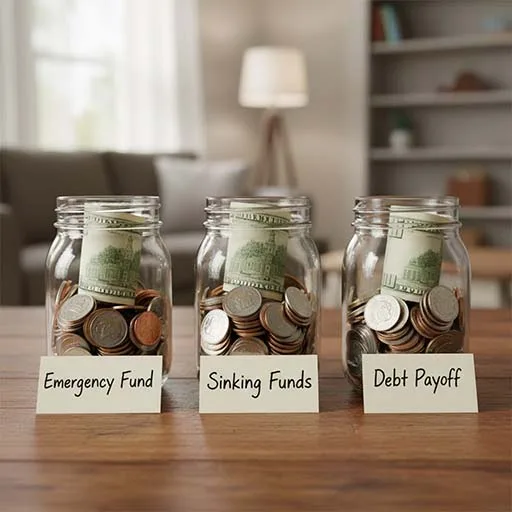
Building an emergency fund and sinking funds
The second bucket is for security: saving and paying down debt. Two concepts are especially powerful here:
- Emergency fund – a cushion for job loss or big unexpected bills
- Sinking funds – small, regular savings for expected but irregular expenses (car repairs, holidays, back-to-school costs)
The goal is simple: how to build an emergency cushion on a tight budget without feeling deprived. Even $20–$50 per paycheck into this bucket gradually builds real protection.
Savings goals for beginners and retirement savings
Inside Bucket #2, many people start with savings goals for beginners:
- First $500 for emergencies
- Then one month of expenses
- Then long-term financial goals
Part of those goals usually involves retirement savings. In the U.S., that might include a workplace 401(k) plan, a Roth IRA, or a health savings account (HSA) for medical costs. At a basic, non-technical level, these are tax-advantaged containers that help money grow over decades.
The key is not perfection, but consistent contributions that match a person’s real life.
Where to keep the savings buckets
Security money doesn’t all have to sit in the same place. People often spread it across:
- A high-yield savings account for the emergency fund
- A certificate of deposit for medium-term goals that can sit untouched
- A money market account for larger balances they still might need within a year or two
Each bucket can have its own account name, so a person instantly knows what it’s for when they log in.
Automating savings and transfers
Automation turns good intentions into habit. Many workers use direct deposit to send part of each paycheck straight into savings. Others rely on an automatic bank transfer that moves money from checking to savings a day after payday.
This is exactly how to automate savings each payday: pay future goals before discretionary spending. Banks’ online banking dashboard tools make it easy to set these rules once and leave them running.
Over time, people can use a spreadsheet or app to see how to track progress toward savings goals and adjust the amounts as income grows. This is also how they how to prioritize savings first without having to think about it every week.
Balancing debt and savings: a simple debt payoff roadmap
Within Bucket #2, many people still carry debt. A sensible plan includes making at least the minimum payment on every account, then choosing a focused strategy like the debt snowball method (smallest balance first) or debt avalanche method (highest interest rate first).
A blended approach becomes a simple debt payoff roadmap: protect the household with an emergency fund, then channel extra dollars into the chosen debt strategy.
The real art is learning how to balance debt payments and savings. No one wants to stop saving entirely, but ignoring debt slows progress. A clear plan in Bucket #2 makes it easier to slowly how to stop living paycheck to paycheck over time.
Bucket #3 – Lifestyle and giving: discretionary spending with purpose
Discretionary spending without guilt
The third bucket covers discretionary spending—dining out, streaming subscriptions, hobbies, gifts, and small luxuries. When this money is clearly separated from essentials and security, people can enjoy it without guilt.
Instead of wondering if they “should” spend, they simply check the balance of the Lifestyle & Giving bucket. If there is money there, they can spend it freely.
Budget friendly lifestyle changes and everyday frugal living tips
A powerful part of this bucket is making budget friendly lifestyle changes that do not feel extreme:
- Choosing one streaming service instead of five
- Hosting friends at home instead of pricey nights out
- Choosing experiences over expensive items
These everyday decisions pair nicely with everyday frugal living tips like meal prep, buying staples in bulk, and shopping second-hand for clothing and furniture.
Giving and generosity in practice
For many households, generosity is non-negotiable. The Lifestyle & Giving bucket is where the spend save give method really shines. Instead of giving randomly, people can plan small, consistent gifts that fit inside family-friendly budget ideas, such as:
- Setting aside a set amount each month for charity
- Saving for holiday giving through the year
- Creating “giving envelopes” for spontaneous generosity
Controlling impulse spending in the lifestyle bucket
Even with a set lifestyle budget, impulse is still a factor. That is why tips to control impulse spending matter. Before buying, people may ask themselves a few questions to ask before buying something, such as:
- “Do I already own something similar?”
- “Can I wait 24 hours and see if I still want this?”
Keeping a separate account for this bucket is often the best way to separate bills savings and fun money. Checking that balance before spending adds a natural pause and supports that stress free budgeting routine.
Step by step guide to creating a first three-bucket budget
Step 1 – Know your household net income
Any step by step guide to creating a first budget begins with knowing what comes in. That means calculating household net income—the amount after taxes, insurance, and retirement contributions are taken out.
Once this number is clear, it is easier to design a paycheck allocation strategy that feeds each of the three buckets in a predictable way.
Step 2 – Choose high level budget categories and percentages
Next comes deciding how to divide income into three buckets. This is where percentage based budgeting is useful. Many people start with a variation of the 50/30/20 budgeting rule:
- 50% for essentials
- 30% for lifestyle
- 20% for savings and debt
This is just a starter budget for beginners, not a rigid rule. Some may wonder, “how much should I save from each paycheck?” For many households, 10–20% is a realistic starting range that still leaves room for necessities and joy.
Example: starter budget for beginners
Imagine a household with $4,000 in monthly net income:
- Essentials: $2,200
- Security: $800
- Lifestyle & Giving: $1,000
This layout shows where trade-offs might be needed and where how to keep your budget simple and flexible matters more than perfection.
Adjusting percentages for a low income budgeting plan
For a low income budgeting plan, essentials may need 70–80% of income, especially with high rent. In that case, small amounts still go to security and lifestyle to keep momentum and motivation alive.
Micro-adjustments for planning for irregular income and self employment
Some people earn variable income. For them, planning for irregular income matters more than exact monthly numbers. Freelancers and gig workers often ask how to budget if you are self employed. A common approach is:
- Average income from the last 3–6 months
- Use a conservative baseline
- Adjust buckets quarterly instead of monthly
Step 3 – Choose categories for a starter budget
Next comes deciding how to choose categories for a starter budget inside each bucket:
- Essentials: rent, utilities, groceries, transport, insurance
- Security: emergency fund, sinking funds, debt extra payments
- Lifestyle: eating out, entertainment, holidays, giving
Keeping this list short protects people from overcomplicating personal finance basics for adults and makes it easier to track progress.
Step 4 – Pick tracking tools they’ll actually use
Finally, tools. Options include:
- Printable or online practical budgeting worksheets
- Simple digital budgeting tools for beginners
- A basic budgeting spreadsheet template in Excel or Google Sheets
- A mobile budgeting app that syncs with bank accounts
- Lightweight expense tracking software for those who like dashboards
Some prefer pen and paper. For them, a notebook is an easy way to track expenses. Others want to know how to track daily expenses without apps; they might carry a small notepad or use a simple note on their phone and update once a day.
Tools, accounts, and systems: how to use bank accounts as spending buckets
Using bank accounts instead of envelopes
Many households like how to use bank accounts as spending buckets. A simple setup might look like:
- One checking account for Essentials
- One high-yield savings account for Security
- One smaller checking or savings account for Lifestyle & Giving
Those who love cash can still use the envelope budgeting method. They simply assign envelopes under each bucket, showing how to use cash envelopes with a three bucket system without sacrificing structure.
Direct deposit and automatic transfers
When employers allow split deposits, direct deposit can send money into multiple accounts from day one. Whatever cannot be split at payroll can be moved with an automatic bank transfer as soon as the paycheck arrives.
This automation supports the idea that automation is one of the easy budgeting rules that actually work over the long haul.
Digital dashboards and tracking
Most banks and credit unions offer an online banking dashboard. Within that dashboard, people can:
- Watch balances in each bucket
- Monitor debit card transactions in real time
- Connect accounts to a mobile budgeting app or expense tracking software
Alerts and labels further support weekly budget check in habits.
Adapting the three-bucket method to real life in the US
Budgeting for working parents and families
For parents, budgeting for working parents is about managing childcare, school expenses, and limited time. The three-bucket structure helps with cash flow planning for families across the school year, summer, and holiday seasons.
Many families create family-friendly budget ideas like:
- Friday home movie nights instead of theater trips
- Potluck gatherings instead of eating out
- Free local events rather than expensive attractions
These choices free up room in the Lifestyle bucket while keeping fun on the calendar.
Young professionals, renters, and minimum wage workers
A lot of younger adults need money management for young professionals that also respects high rents and student loans. For them:
- Essentials may be heavy with housing
- A realistic budget for renters sets clear rent and utilities caps
- Those on budgeting on minimum wage focus first on essentials and a tiny but consistent security bucket
For each group, adjusting percentages keeps the three buckets working in their favor.
Different pay schedules: weekly, biweekly, and irregular income
Pay schedules also matter. Many workers want to know how to budget if you are paid weekly or how to budget if you are paid biweekly.
- Weekly: smaller, more frequent transfers into each bucket
- Biweekly: two large paychecks; many people treat one as “bills + savings” and the other as “bills + lifestyle”
For those with side hustles or project-based work, planning for irregular income means smoothing out highs and lows with a buffer and realistic expectations.
Debt, credit, and the three-bucket plan
Understanding credit score and credit report
To support the security bucket, households need a basic understanding of credit score and credit report. Paying at least the minimum payment on time every month is one of the fastest ways to protect both.
As debt falls and payments are made reliably, better credit reduces interest costs, which feeds back into all three buckets.
Choosing a debt payoff strategy
Within the Security bucket, people choose between methods like debt snowball method (smallest balance first) or debt avalanche method (highest interest rate first). Either can be plugged into the three-bucket structure as part of that simple debt payoff roadmap.
Getting out of the paycheck-to-paycheck cycle
Breaking out of that cycle usually requires:
- A small emergency fund
- Consistent sinking funds for predictable but irregular bills
- A smarter paycheck allocation strategy
That is how households gradually how to stop living paycheck to paycheck — not overnight, but through many small, intentional decisions.
Everyday frugal habits that make the buckets work
Lifestyle tweaks that don’t feel restrictive
Effective change doesn’t have to feel harsh. Budget friendly lifestyle changes such as reducing takeout by one meal a week or sharing streaming accounts within a household can free up noticeable cash.
Combined with everyday frugal living tips like batch cooking, using a grocery list, and looking for second-hand deals, these changes boost the Security bucket without eliminating joy.
Smart spending habits and impulse control
Smart spending is about building habits. Using tips to control impulse spending and pausing to run through a few questions to ask before buying something helps people slow down in the Lifestyle bucket. Over time, these habits support that stress free budgeting routine the three-bucket method is known for.
Teaching kids about money
A simple way to teach kids about budgeting is to give them three jars labeled: Spend, Save, Share. This is the three-bucket idea scaled down for children, mirroring the spend save give method. Kids learn early to assign money to different purposes and watch it grow over time.
Reviewing, resetting, and keeping the budget simple and flexible
Weekly budget check in
A weekly budget check in can be as quick as 10–15 minutes. Many people open their accounts, glance at each bucket, and adjust any near-term plans. This routine reinforces how to keep your budget simple and flexible instead of obsessing over every purchase.
Monthly review and adjustments
Once a month, a slightly deeper look helps people how to review last month’s spending. They can also think through how to review your budget at the end of the month with questions like:
- Did we overspend in any bucket?
- Did we move closer to our goals?
- Do any percentages need fine-tuning?
Comparing the original plan to actual household net income and outflows keeps the system aligned with reality.
Handling raises and surprise expenses
Life changes constantly. When income rises, people often wonder how to adjust a budget after a raise. A simple principle is to send part of every raise into the Security bucket—boosting retirement savings and other financial goals—before increasing lifestyle.
On the flip side, surprises happen. Learning how to handle surprise expenses in a budget, often by tapping sinking funds and the emergency fund, prevents crises from derailing long-term plans.
When things go off track
Everyone slips. That is why knowing how to reset your budget after overspending matters. Instead of quitting, households can:
- Pause extra spending
- Rebalance the buckets for the next month
- Revisit essentials and discretionary items
This reset process helps those who how to start budgeting when you feel overwhelmed to move forward again, one step at a time.
Long-term consistency and mindset
Ultimately, success with the three-bucket method is about how to stick to a budget long term. It’s less about perfection and more about progress: small wins, regular check-ins, and flexibility when life changes.
Who is behind this three-bucket guide?
Background as a personal finance coach
Behind this approach is a personal finance coach who has spent years helping U.S. households design a simple budget plan usa that matches their values and circumstances. This experience includes:
- Building plans for a low income budgeting plan
- Crafting strategies for budgeting on minimum wage
- Designing a realistic budget for renters in high-cost cities
Because the framework is simple, it works across income levels and life stages.
How the system is applied in real life
In practice, this coach has worked with clients who start with digital budgeting tools for beginners, then gradually move to a lean budgeting spreadsheet template when they understand their patterns.
Many have seen real progress by funneling savings into a high-yield savings account funded with an automatic bank transfer, watching their balances grow month after month.
FAQs – Three-bucket budgeting in the US
FAQ 1 – How much should someone save from each paycheck in the three-bucket plan?
People often ask how much should I save from each paycheck. There is no single number, but a common starting point is 10–20% of net income for the Security bucket. This fits well within percentage based budgeting and the 50/30/20 budgeting rule.
As income grows or debt shrinks, that percentage can slowly increase, accelerating progress toward long-term goals.
FAQ 2 – What is the best way to separate bills, savings, and fun money in the US?
The best way to separate bills savings and fun money is usually to use separate accounts:
- One checking account for Essentials
- One high-yield savings account for Security
- One smaller account for Lifestyle & Giving
Using direct deposit and transfers keeps money flowing into each area without extra effort.
FAQ 3 – How can someone budget if they are paid weekly or biweekly?
Those wondering how to budget if you are paid weekly or how to budget if you are paid biweekly can start by assigning a percentage of each paycheck to each bucket and moving that amount as soon as the money arrives.
Weekly pay often leads to smaller, more frequent transfers, while biweekly pay usually works best with a schedule tied to bill-due dates.
FAQ 4 – Can cash envelopes work with the three-bucket system?
Yes. People who like physical cash often ask how to use cash envelopes with a three bucket system. They can create envelopes for Essentials, Security (like savings and debt extra payments), and Lifestyle & Giving.
This approach blends the three-bucket design with the familiar envelope budgeting method.
FAQ 5 – How should someone start budgeting when they feel overwhelmed?
When someone wonders how to start budgeting when you feel overwhelmed, the best first step is often a single weekly budget check in and a very simple budgeting spreadsheet template or paper worksheet.
Focusing on just three buckets instead of dozens of categories keeps stress low and builds confidence.
FAQ 6 – How can people stop living paycheck to paycheck in the US?
To how to stop living paycheck to paycheck, households typically need:
- A starter emergency fund
- A clear view of household net income
- A better paycheck allocation strategy that feeds all three buckets
Over time, even small changes can add up to meaningful breathing room.
FAQ 7 – How can self-employed people budget with irregular income?
Those asking how to budget if you are self employed while planning for irregular income often benefit from:
- A separate account for taxes
- Another for business income
- A fixed “paycheck” transferred monthly into personal accounts
From there, the three buckets operate like they would for any salaried worker.
FAQ 8 – Is it possible to manage this system without apps?
Yes. Many prefer pen and paper and ask how to track daily expenses without apps. A notebook, calendar, or simple ledger can work well.
Others use practical budgeting worksheets, then later try a mobile budgeting app or expense tracking software when they’re ready for more automation and visual reports. Either way, they still have an easy way to track expenses.
FAQ 9 – How can someone review their spending each month in a simple way?
A monthly review helps people how to review last month’s spending and how to review your budget at the end of the month. A simple process is:
- Look at total income
- Check how much went into each bucket
- Decide if any percentages need adjustment
Doing this consistently keeps the three-bucket plan aligned with real life.
FAQ 10 – When should someone consider working with a personal finance coach?
Working with a personal finance coach can be helpful when:
- Debt balances feel unmanageable
- It is hard to how to balance debt payments and savings
- A person feels stuck even with a three-bucket plan in place
A coach can tailor the structure to specific circumstances and help refine the buckets and habits over time.
Author Bio
Silvia Heart is a personal finance writer who focuses on simple, real-life budgeting strategies for everyday families.
Published by: Ahmed Saeed.